In 2026, the choice between manual and CNC machining still depends on the part, production volume, budget, and available skills. Manual machines rely on an operator to guide cutting tools and adjust settings. CNC machines follow programmed instructions to control tool movement. The distinction is visible on the shop floor: one machinist may turn a handwheel to shape a metal shaft, while a CNC mill repeats a toolpath across several parts. Small differences matter.
A practical answer to what is the difference between manual and CNC machining starts with control, not a claim that one method is always better. Manual machining can suit one-off parts, repairs, and jobs that need frequent hands-on adjustment. CNC machining is often useful for repeatable dimensions, complex toolpaths, and larger batches, though setup and programming take time. Neither process removes the need for sound drawings, suitable tooling, careful inspection, and an experienced machinist. Machines can repeat a mistake very consistently.
This guide compares setup, accuracy, speed, cost, flexibility, and typical applications. It also considers where the two methods can complement each other in one workshop. Actual results vary with machine condition, material, tolerances, and operator experience, so broad comparisons should be treated as starting points, not guarantees. A shop choosing between them should examine its real parts and workflow. That step is easy to overlook.
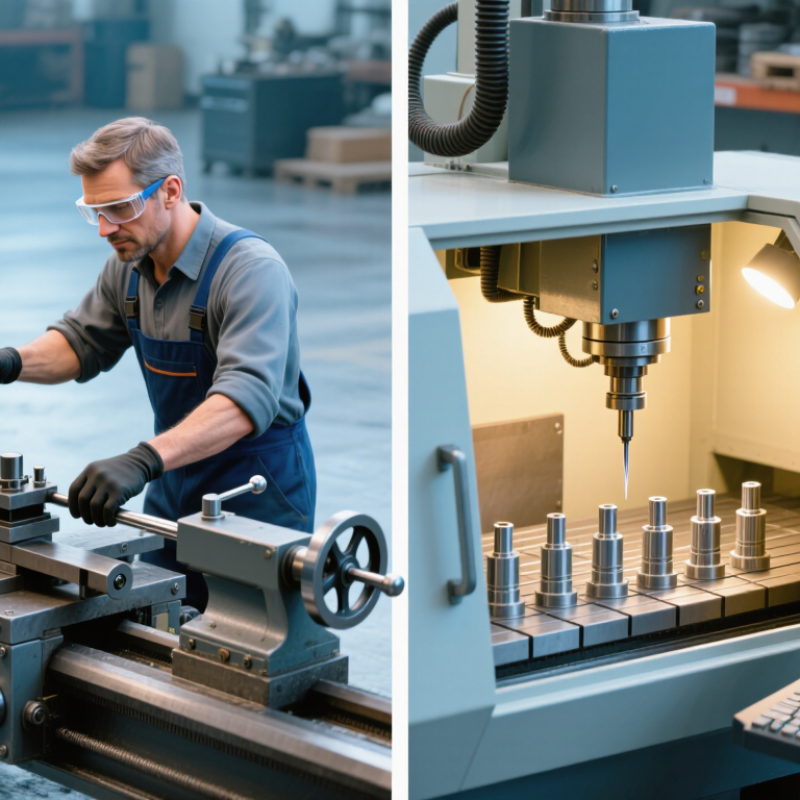
Manual machining is controlled directly by the operator. The machinist turns handwheels, moves levers, and adjusts feed or cutting depth while watching the tool meet the material. On a vertical mill, X usually moves the table left and right, Y moves it front to back, and Z moves the spindle up and down. A manual machine can have these same axes as a CNC machine. Axis count describes possible motion, not how motion is controlled.
CNC machining uses a programmed controller to coordinate motors and move cutting tools along a planned path. A three-axis mill typically moves along X, Y, and Z; additional rotary axes let the workpiece or tool tilt and rotate. More axes can reach complex surfaces, but do not guarantee better accuracy. Setup, tool condition, and workholding still matter. The distinction is useful, but not absolute: operators also make hands-on adjustments around CNC machines. Deloitte and the Manufacturing Institute’s 2024 workforce study estimates that 3.8 million manufacturing jobs may be needed in the United States by 2033, with 1.9 million potentially unfilled. That skills gap makes practical knowledge of both machine movement and controller behavior valuable. Small details matter. A wrong axis offset can send a cutter into a clamp.
| Comparison Dimension | Manual Machining | CNC Machining |
|---|---|---|
| Control method | The operator directly moves machine components using handwheels, levers, switches, and other controls. | A controller reads programmed instructions and commands machine motions and functions through drive and control systems. |
| How motion is specified | The operator sets and adjusts movement during the operation, often by reading graduations, indicators, or measuring tools. | Tool paths are usually defined with coordinates, machining operations, and cutting parameters in a part program. |
| Meaning of machine axes | Axes describe directions in which the machine can move, but the operator generally controls each movement directly. | Axes describe controlled machine movements. The program and controller coordinate the commanded axis positions and motions. |
| Common axis arrangements | A manual lathe commonly has two primary working axes; a manual milling machine commonly provides three linear axes. Configurations vary. | Many CNC lathes use two primary axes and many CNC mills use three linear axes. Four- and five-axis configurations are also available. |
| Simultaneous axis movement | Movement is typically guided and coordinated by the operator, making complex simultaneous motions more demanding. | Depending on the machine and program, multiple axes can move together along a coordinated tool path. Not every CNC machine supports simultaneous movement on every axis. |
| Repeatability | Results depend substantially on operator technique, setup, workholding, machine condition, and measurement. | Programmed motions can be repeated consistently when the setup, tooling, material, machine condition, and process are controlled. |
| Part changes | Changing a part or operation often requires the operator to adjust the setup and manually control the machining sequence. | Part changes commonly involve editing or selecting a program and adjusting the setup, tools, work offsets, or parameters as needed. |
| Operator involvement | The operator is closely involved in controlling cutting movements and responding to changes during machining. | The operator prepares and verifies the program and setup, monitors the process, and intervenes when necessary; CNC does not eliminate skilled oversight. |
| Typical strengths | Useful for straightforward work, one-off jobs, adjustments, and operations where direct manual control is practical. | Useful for repeat production, complex programmed paths, and parts requiring consistent automated movement. |
| Important limitation | Production speed and consistency can be affected by manual control demands and operator-to-operator variation. | Performance depends on suitable programming, setup, tooling, machine capability, and process control; CNC does not guarantee a particular tolerance. |
Note: Axis count and capability vary by machine type and configuration. Accuracy, cycle time, and achievable tolerances depend on the machine, setup, tooling, material, and machining process.
It records commanded positions, feed rates, and spindle speeds. It does not capture every operator decision.
Compare the program revision, setup sheet, work offset, tool list, and operator notes. Small changes matter.
An operator may turn an override knob to reduce chatter. The file may not show that adjustment.
Record handwheel movements, selected gear, measurements, and notable decisions. A rushed note may miss the reason for a change.
Use a calibrated laser interferometer or linear scale. Warm up the machine, test both travel directions, and keep raw readings.
Measurements near the travel ends can reveal errors that a single position misses. Keep raw readings.
It may work well for a single bracket, repair, or simple part. Familiar geometry can make setup quick.
Repeated parts, curved profiles, pockets, or tight dimensions may favor CNC. A tiny batch can still lose after setup costs.
Compare quantity, tolerances, inspection needs, setup time, and cost per part. Check actual numbers. Revisit the choice if the design changes.
What is the difference between manual and CNC machining? The main distinction is how machine movements are controlled. In manual machining, an operator directly adjusts controls and guides the cutting tool, relying on skill and attention. CNC machining uses a programmed sequence of movements across one or more axes, allowing the machine to repeat complex operations with less hands-on control. CNC programs commonly use ISO 6983 G-code to specify coordinates, feed rates, and other actions, while manual work depends on the operator’s adjustments at the machine.
Choosing between the two depends on the part and production needs. For general dimensions from 6 to 30 mm, ISO 2768-1 tolerance class m allows ±0.2 mm, but tighter requirements call for careful process planning. CNC axis performance can be evaluated through ISO 230-2 positioning accuracy and repeatability tests. Manual machining may suit simple parts or small batches with minimal setup, whereas CNC can be more efficient for complex shapes, repeat production, and larger batches. Compare setup time, operator effort, required accuracy, and cost per part before deciding.

 DSCUT CNC