For buyers, understanding what are the latest trends in CNC machining technology requires more than comparing machine prices. Modern workshops are investing in connected controls, robotic loading, digital twins, adaptive cutting, and real-time process monitoring. These technologies can reduce setup delays, stabilize tool life, and improve consistency across repeated production runs.
W. Edwards Deming, a respected manufacturing quality expert, said, “Without data, you’re just another person with an opinion.” His principle remains highly relevant to CNC purchasing. A machine with sensors, production dashboards, and predictive maintenance tools can reveal spindle load, vibration, temperature, and cycle-time changes. However, data alone does not guarantee better parts. Operators still need practical training, disciplined inspection, and reliable process documentation.
Energy efficiency is also influencing buyer decisions. High-efficiency motors, regenerative drives, coolant filtration, and optimized toolpaths can lower operating costs beside the machine. Automation is expanding beyond large factories, too. Compact cobots now support loading, unloading, pallet changes, and inspection in smaller facilities. Still, integration can be difficult. A robot may remain idle if fixtures, software, or safety systems are poorly matched.
This guide examines the trends that matter during real purchasing decisions. It considers accuracy, software compatibility, service response, cybersecurity, operator experience, and total cost of ownership. Some predictions will be wrong. Technology moves unevenly. Buyers should request test cuts, inspect sample parts, review supplier references, and measure actual cycle times before committing to a fashionable feature.
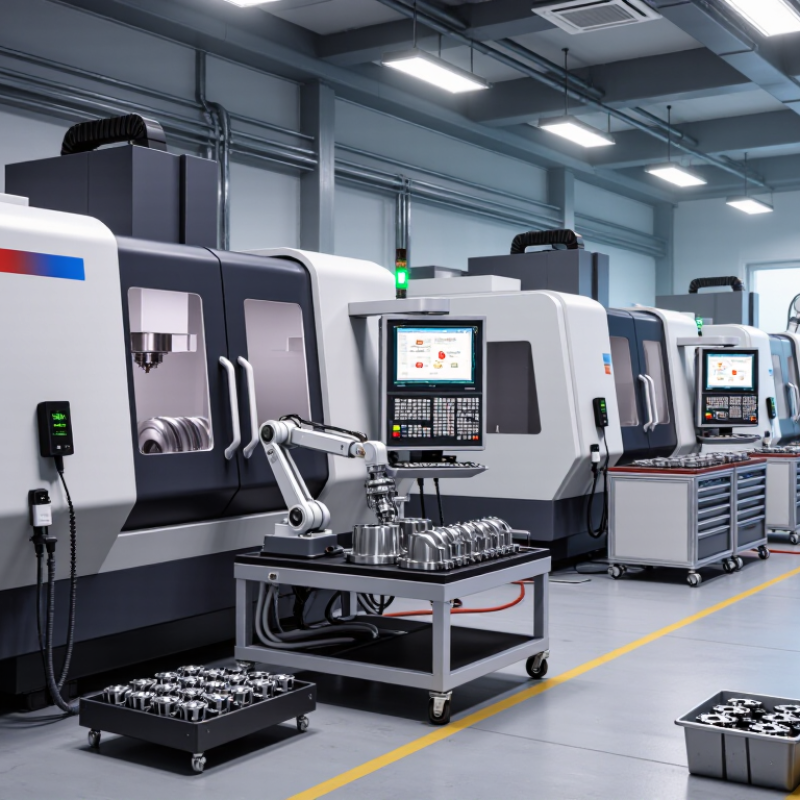
China’s CNC machining market is moving from basic volume production toward connected, high-precision manufacturing. Buyers now examine more than machine quantity. They ask about five-axis capability, in-process probing, automatic tool measurement, and production data control. These technologies reduce setup errors when parts contain deep pockets, angled holes, or narrow tolerances. A useful factory visit should include a first-article inspection and a review of measurement records.
Digital systems are changing daily production work. Shop-floor machines can send cycle data to planning software, while barcode tracking links each component to its material certificate and inspection result. This matters for aerospace, medical, automotive, and industrial equipment buyers. Clear traceability helps engineers investigate a failure without guessing. It also supports repeat orders when drawings change slightly. Ask to see real records, not only presentation slides.
Automation is valuable, but it is not automatically better. A robotic loading system may improve consistency, yet poor fixture design can repeat the same mistake faster. I have seen buyers focus on spindle speed while overlooking operator training and inspection discipline. That is a costly blind spot. China’s manufacturing market offers strong technical depth, but capability varies between suppliers and even between production lines. Buyers should compare sample parts, tolerance reports, maintenance practices, and communication habits before approving long-term production. Fast quotes can hide slow problem-solving.
Chinese CNC suppliers increasingly combine several machining technologies to meet tight tolerances, varied materials, and shorter delivery schedules. For buyers, the key question is not machine quantity. It is whether the process matches the part’s actual risks.
Three-axis milling handles many brackets, plates, and housings efficiently. Five-axis machining reaches angled surfaces with fewer setups, reducing alignment errors. Turning centers suit shafts, bushings, and threaded components. Some suppliers also combine turning and milling in one machine. This can shorten handling time, but programming becomes more demanding. Buyers should request sample process plans, not only equipment lists.
Electrical discharge machining works well for hardened metals, narrow slots, and complex cavities. Wire EDM can produce sharp profiles that conventional cutting may struggle to achieve. Laser cutting supports fast sheet-metal preparation, while surface grinding improves flatness and finish. Automated probing checks dimensions during production. It can catch tool wear earlier. However, automation does not replace sound measurement routines.
Reliable suppliers connect CAD/CAM programming, machining, cleaning, and inspection through documented procedures. Ask for capability studies, material certificates, inspection records, and realistic tolerance notes. A quoted tolerance may be technically possible but expensive to maintain across large batches. That detail is often missed. Buyers should also examine burr control, corner radii, surface texture, and packaging protection. Complex technology is useful, but unnecessary complexity can increase cost and create new failure points.
China’s CNC machining buyers are watching automation move from isolated machines to connected production cells. Tool wear sensors, automatic loading, and real-time dashboards now support faster decisions on the shop floor. According to the International Federation of Robotics’ World Robotics 2024 report, China installed 276,288 industrial robots in 2023, representing about 51% of global installations. This scale matters for CNC suppliers. Buyers can expect more lights-out machining, but only when fixtures, cutting tools, and inspection routines are stable.
Digitalization also changes how production quality is managed. A connected CNC line can record spindle load, vibration, tool life, and dimensional results after each batch. Engineers can then identify drift before a rejected part reaches assembly. Deloitte’s 2024 Smart Manufacturing and Operations Survey found that 86% of manufacturers view smart manufacturing as a major competitiveness driver within three years. The figure is persuasive, though not a guarantee.
Data alone does not fix weak processes. A dirty sensor can produce confident but wrong alerts. Poor data standards can also trap information inside separate machines. Buyers should examine system compatibility, operator training, cybersecurity controls, and offline recovery procedures. Ask to see actual production records, not only a polished demonstration. Automation saves labor, but careless automation can repeat mistakes faster.
How Automation and Digitalization Are Changing CNC Production
Global industrial robot installations increased strongly from 2019 to 2022, highlighting the growing role of automation in modern CNC production. For buyers, this trend supports evaluating robotic machine tending, automatic tool monitoring, in-process inspection, production data connectivity, and predictive maintenance capabilities when comparing suppliers.
Source: International Federation of Robotics, World Robotics reports. Figures represent annual global industrial robot installations, not CNC machines alone.
China’s CNC machining capabilities now cover rapid prototyping, five-axis production, and complex metal assemblies. Buyers should evaluate process control, not only attractive sample parts. A clean surface can hide unstable dimensions.
Ask for inspection records from similar materials and geometries. Confirm tolerance data with coordinate measuring machine reports, not verbal promises. Review equipment age, spindle condition, tool management, and preventive maintenance schedules. A capable supplier should explain how it controls heat distortion, burrs, and batch variation.
Material traceability matters. Request mill certificates, lot numbers, and clear inspection procedures. Check whether the supplier can support first-article inspection, process capability studies, and reliable export documentation. Communication also deserves testing. Send a technical drawing with one difficult tolerance and observe the questions received. Vague replies are warning signs.
Tips: Request a small pilot batch. Measure critical features independently. Compare results across several parts. Ask how rejected parts are investigated. A strong corrective-action report should identify the cause, not simply promise improvement. Do not choose from price alone. In practice, even experienced buyers sometimes overestimate a factory after one successful run. Capacity can change during peak seasons, and outsourced processes may remain undisclosed. Include these risks in your evaluation.
| Technology Trend / Capability | Why It Matters to Buyers | Key Evaluation Dimensions | Indicative Technical Benchmark | Evidence to Request |
|---|---|---|---|---|
| 5-Axis and Multi-Axis Machining | Reduces setups, improves access to complex surfaces, and can shorten cycle time for aerospace, medical, mold, and precision industrial parts. | Machine configuration, simultaneous versus indexed 5-axis capability, rotary-axis accuracy, work envelope, and post-processor control. | Positioning accuracy and repeatability should be verified against the machine specification and an applicable test standard; actual results depend on part size and thermal conditions. | Recent machine inspection records, calibration certificates, sample 5-axis parts, and a documented setup plan. |
| High-Speed and High-Efficiency Cutting | Supports shorter production cycles and better surface quality when machining aluminum, engineering plastics, graphite, and certain steels. | Spindle speed, spindle power, machine rigidity, toolholding, vibration control, chip evacuation, and validated cutting parameters. | A suitable spindle speed range and power rating should be matched to the material, cutter diameter, tolerance, and required surface finish rather than assessed by speed alone. | Material-specific cutting data, cycle-time study, tool-life records, and surface-finish samples. |
| Automation and Robotic Workholding | Improves repeatability and machine utilization for recurring batches while reducing manual handling and setup variation. | Pallet systems, robotic loading, fixture repeatability, unattended operation, safety controls, and changeover time. | The buyer should compare planned versus actual machine utilization, setup duration, first-pass yield, and the number of stable unattended operating hours. | Production records from comparable parts, automation layout, risk assessment, fixture drawings, and changeover video or work instructions. |
| In-Process Probing and Closed-Loop Inspection | Detects tool wear, workpiece misalignment, and dimensional drift before a batch of parts is completed. | Probe calibration, tool-break detection, automatic offset correction, measurement strategy, and alarm response. | Probe performance should be demonstrated using a controlled repeatability study and correlated with final inspection results. | Probe calibration reports, control plans, measurement logs, nonconformance examples, and corrective-action records. |
| Digital Manufacturing and Traceability | Creates a verifiable link between material, program revision, operator, machine, inspection data, and shipment lot. | ERP or MES integration, revision control, barcode or serial tracking, data retention, cybersecurity, and auditability. | Every production lot should be traceable to material certificates, approved drawings, process records, inspection results, and shipment documentation. | An anonymized digital traveler, revision-history sample, traceability matrix, data-retention policy, and access-control procedure. |
| Advanced CAD/CAM and Simulation | Reduces collision risk, improves toolpath quality, and enables reliable machining of complex geometries. | Software capability, 3D model handling, post-processor validation, digital simulation, revision control, and engineering response time. | Toolpaths should be simulated for holder, tool, fixture, stock, and machine-axis collisions before release to production. | Simulation screenshots or reports, sample toolpaths, engineering change records, and proof of controlled program release. |
| Tight-Tolerance Process Control | Determines whether the supplier can repeatedly meet functional dimensions rather than only pass an occasional sample inspection. | GD&T interpretation, process capability, thermal control, fixture stability, measurement uncertainty, and corrective action. | For critical characteristics, request capability evidence such as Cpk or equivalent analysis; acceptance criteria should be agreed for each drawing requirement. | FAI or first-article report, control plan, process-capability study, calibration records, and dimensional trend charts. |
| Multi-Material Machining Expertise | Different materials require different tooling, speeds, feeds, coolants, deburring methods, and contamination controls. | Aluminum, stainless steel, titanium, copper alloys, plastics, hardened steels, tool selection, and material segregation. | Material certificates should identify grade, specification, heat or lot number, and required mechanical or chemical condition where applicable. | Material certificates, tooling recommendations, sample parts, contamination-prevention procedures, and deburring standards. |
| Integrated Metrology and Surface Measurement | Provides objective confirmation of dimensions, form, position, and surface quality for regulated or high-value components. | Coordinate measuring machine capability, optical measurement, surface roughness testing, calibration, and measurement programming. | Measurement equipment should be selected according to feature size, tolerance, surface condition, and required measurement uncertainty. | Equipment list, calibration certificates traceable to recognized standards, sample inspection reports, and measurement-system studies. |
| Surface Finishing and Secondary Processes | A coordinated finishing chain reduces handling risk, lead-time variability, and quality disputes after machining. | Deburring, anodizing, plating, passivation, heat treatment, painting, masking, subcontractor control, and final inspection. | The process must be matched to the specified finish, thickness, color, hardness, corrosion resistance, and dimensional allowance. | Process certificates, finish samples, subcontractor qualification records, masking drawings, and post-finish dimensional reports. |
| Lean Production and Shorter Lead Times | Improves delivery reliability and makes prototype-to-production transitions easier to manage. | Capacity planning, queue time, setup reduction, scheduling discipline, raw-material availability, and on-time delivery performance. | Lead-time commitments should distinguish engineering, material procurement, machining, finishing, inspection, and shipping time. | Anonymized delivery records, capacity plan, production schedule, bottleneck analysis, and escalation procedure. |
| Energy Efficiency and Sustainable Manufacturing | Can reduce operating cost and support environmental requirements in the buyer’s supply chain. | Machine energy monitoring, coolant management, chip recycling, waste segregation, renewable-energy accounting, and environmental compliance. | Sustainability claims should be supported by measured data, defined boundaries, reporting periods, and documented calculation methods. | Energy records, waste-transfer documents, coolant-management procedures, environmental objectives, and relevant audit reports. |
Note: Indicative benchmarks are general procurement guidance, not universal acceptance limits. Final requirements should be defined by the engineering drawing, applicable standards, material specifications, inspection plan, and approved sample results.
China’s CNC machining industry is moving toward smarter, more connected production. Factories increasingly combine multi-axis equipment, robotic loading, and real-time machine monitoring. These systems can reduce setup delays and improve repeatability for complex parts. Digital twins are also gaining attention. Engineers can test tool paths virtually before cutting metal. That saves material, time, and sometimes expensive mistakes.
Inspection technology is becoming more important for international buyers. Automated vision systems, in-process probing, and coordinate measuring machines help verify dimensions at different stages. Reliable suppliers should provide material certificates, inspection records, and clear process documentation. Buyers should also ask about traceability from raw stock to final packaging. Small details matter.
Green manufacturing is another emerging direction. More facilities are reducing cutting-fluid waste, improving energy control, and recycling metal chips. However, environmental claims need evidence. A modern dashboard does not guarantee better production. Poor data can produce confident errors. AI is useful, but it cannot replace skilled process engineers. Buyers should review sample reports, tolerance results, corrective-action records, and production capacity before approving a supplier. The fastest quotation may not offer the most dependable long-term value.
Ask to inspect a first-article report and recent measurement records. Check five-axis equipment, probing systems, and automatic tool measurement. Do not trust slides alone.
It helps machine angled holes, deep pockets, and complex surfaces with fewer setups. Fewer setups can reduce alignment errors. But programming costs more.
Turning centers usually suit shafts, bushings, and threaded components. Combined turning and milling can reduce handling time. It also requires stronger programming control.
Barcode tracking can link each component to its material certificate and inspection result. Engineers can investigate failures without guessing. Data is helpful, not magical.
No. Automatic loading may improve consistency, but poor fixtures can repeat the same mistake faster. That risk is easy to overlook.
Request spindle load, vibration, tool-life, and dimensional records. Compare actual production data with inspection results. A polished dashboard proves very little.
Ask whether the tolerance is realistic for the full batch. A technically possible tolerance may become expensive to maintain. I would also check corner radii, burrs, and surface texture.
Review material certificates, capability studies, inspection reports, and process plans. Confirm that drawings, materials, and results are linked. Missing records create uncomfortable uncertainty.
Incompatible systems may isolate data between machines. Dirty sensors can trigger incorrect alerts. Check operator training, cybersecurity controls, and offline recovery procedures.
Compare sample parts, tolerance reports, maintenance routines, packaging protection, and communication habits. Fast quotations can hide slow problem-solving. I would not approve long-term production too quickly.
China’s CNC machining industry has become a vital part of the global manufacturing market, offering capabilities that range from conventional milling and turning to multi-axis machining, precision grinding, and advanced inspection. For buyers, understanding what are the latest trends in CNC machining technology is essential when evaluating potential suppliers. Key considerations include equipment accuracy, material expertise, production capacity, quality control systems, engineering communication, lead times, and the ability to meet consistent specifications across different production batches.
Automation and digitalization are reshaping Chinese CNC production through connected machinery, automated tool management, real-time process monitoring, and data-based quality analysis. These developments help improve efficiency, reduce human error, and support more flexible manufacturing. Looking ahead, the industry is expected to focus increasingly on intelligent production, sustainable resource use, faster prototyping, higher precision, and integrated manufacturing services. Buyers who assess both current capabilities and future development plans will be better positioned to select reliable machining partners and achieve stable, cost-effective production.
DSCUT CNC